
Treating chronic foot pain is not that simple, and unfortunately, there is no miracle cure. For a condition that’s not only serious but debilitating, the road to recovery can be challenging and lengthy, leaving you feeling hopeless and, at times, stripped of the things you love doing./p>
Chronic foot pain and musculoskeletal conditions affecting your lower limbs can have a significant impact on your mood, sense of wellbeing, and quality of life. So if for months you have experienced throbbing pain in your legs, pounding aches every time your foot hits the pavement or a stabbing soreness even when you are off your feet, and you haven’t found a treatment to alleviate these symptoms, Shockwave therapy could be the solution for you.
Extracorporeal Shockwave Therapy (ESWT) is an effective, non-surgical treatment that is used to treat a variety of musculoskeletal conditions. It uses high-energy sound waves to stimulate the body’s natural healing processes and improve blood flow to the affected area. Originally Shockwave therapy was introduced in medicine as a treatment method for breaking down kidney stones to help people avoid going through a painful surgical process.
Shockwave therapy has been approved by NICE (The National Institute for Health and Clinical Excellence) as a safe clinical practice to treat conditions involving tendons, muscle and even bones, such as Plantar Fasciitis, Achilles Tendinopathy, Patella Tendinopathy, back pain, and shin splints.
How does Shockwave therapy work?
Shockwave therapy works by creating mechanical energy that is delivered to the body’s tissues. This energy stimulates the body’s natural healing processes, which can help reduce pain, improve mobility, and promote tissue repair. The energy delivered by the shockwaves creates microtrauma in the tissues, which triggers the body’s inflammatory response. This response sends a signal to the body to repair the damaged tissue, which can lead to new blood vessel formation and the production of new collagen, which is an important component of healthy connective tissue.
How does Shockwave Therapy work on tendons?
Shockwave therapy is often used to treat conditions that affect tendons, such as tendinopathy. Tendinopathy is a condition that occurs when the tendons become inflamed or damaged, often due to overuse or repetitive stress. Shockwave therapy can help to reduce the inflammation and promote the growth of new tissue in the affected area. This can help to improve the function of the tendons and reduce pain.
During shockwave therapy for tendinopathy, the shockwaves are typically directed at the area where the tendon is affected. This can help to stimulate blood flow to the area, which can promote healing. The treatment can also help to break down any scar tissue that may have formed in the affected area, which can improve the overall health of the tendon.
You can read more about what the Shockwave Therapy treatment involves here.
How is Shockwave Therapy performed?
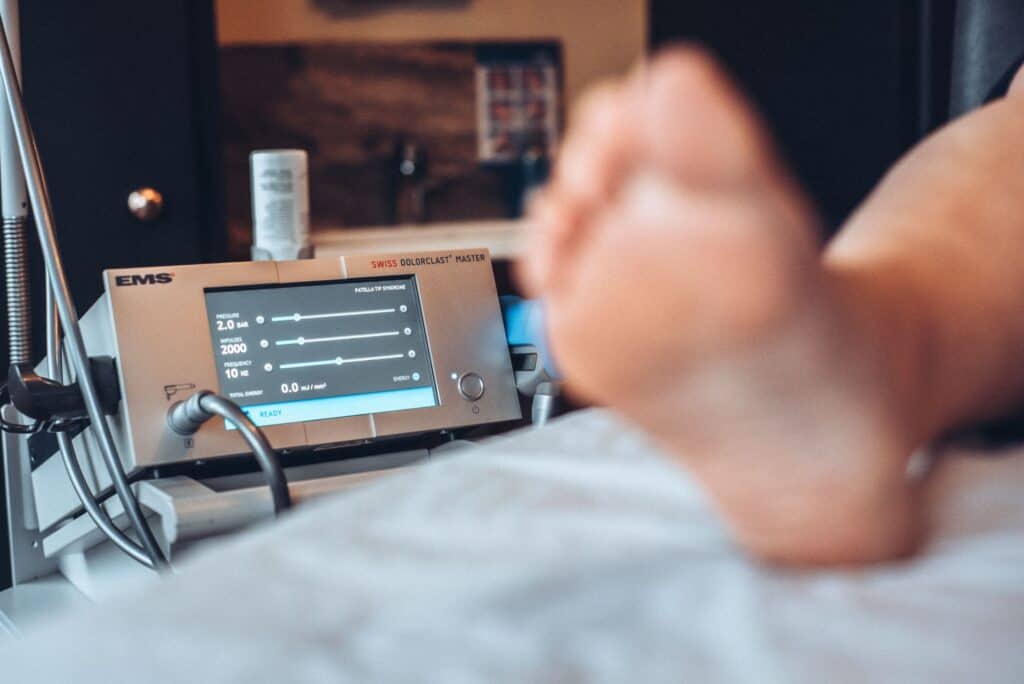
Shockwave therapy is typically performed by a trained healthcare professional, such as a podiatrist, physiotherapist, or chiropractor. The treatment is non-invasive and does not require any anaesthesia. The treatment is delivered through a handheld device connected to a machine. During the process, the device will project focused sound waves to the affected tissues with the objective of increasing the blood flow in the area and kindling your body’s natural healing process. The device is placed on the skin and the shockwaves are delivered in short bursts. The treatment can last between 5 and 20 minutes, depending on the area being treated.
Shockwave therapy uses the power of ultrasound waves to break up the thickened scar tissue without damaging healthy tissue, restoring movement and alleviating the symptoms of pain.
How often should you do Shockwave Therapy?
The frequency of shockwave therapy will depend on the condition being treated and the severity of the symptoms. In general, shockwave therapy is typically performed once a week for three to six weeks. After the initial treatment period, additional sessions may be required to maintain the results. Your podiatrist will be able to advise you on the best course of treatment for your particular condition.
What to do after Shockwave Therapy?
After shockwave therapy, it is important to rest and avoid strenuous activity for a few days. You may experience some discomfort or soreness in the treated area, but this should subside within a few days. Your podiatrist may recommend that you do some stretching exercises or other gentle exercises to help promote healing and maintain mobility.
Is Shockwave Therapy covered by insurance in the UK?
The availability of shockwave therapy on the NHS can vary depending on the location and the specific condition being treated. Some private healthcare providers in the UK do offer shockwave therapy as a treatment option, but it may not be covered by all insurance plans. It is important to check with your insurance provider to see if shockwave therapy is covered under your plan.
When can you have Shockwave Therapy?
At Walk This Way Podiatry, we follow a rigorous medical assessment to determine if Shockwave therapy is the proper treatment for our patients. This assessment starts with an in-depth analysis of your feet which enable us to evaluate your foot health and identify any problems you may be experiencing. It also provides us with necessary information about your medical history, any conditions you suffer and medication you may be taking.
After the assessment, we tailor a personalised treatment plan to help you treat and recover from any musculoskeletal disorder and foot pain. While Shockwave is suitable for most people, there are some conditions or circumstances that can prevent you from going under Shockwave therapy, including:
● If you’re taking pain killers, such as aspirin or ibuprofen. You would need to discontinue using them one week prior to having treatment and one week after.
● If you are taking strong blood-thinning medication for a heart condition, you won’t be a candidate for Shockwave at all.
● If you are on oral anticoagulant medication.
● If you are diabetic, you need to use caution with Shockwave. The reason is because, with diabetes, there will be often a circulatory impairment that can actually worsen the injury. The change of circulation caused by the sound waves can be an issue.
● If you have a tumour, you wouldn’t have Shockwave done either.
● If you have a circulation or nerve disorder or something diagnosed, that isn’t an indication.
● If you have a blood clotting disorder (including thrombosis.)
● If you have received a Steroid injection within six weeks.
● If you have a Pacemaker fitted.
● If you have an infection or skin abrasion at the treatment area.
● If you are Under 18 (except in the treatment of Osgood-Schlatter disease.)
● If you are pregnant, we would need permission from your doctor first.
This list of conditions is not exhaustive. It’ll always depend on your individual medical history and health if you qualify to receive the treatment or not. But rest assured, we will always prioritise your safety in the first place.
From our experience, Shockwave therapy responds better to certain conditions than others. Hence we will always advise it if we know it’ll benefit you and there are no potential risks involved. .
In summary, Shockwave Therapy is an excellent alternative to surgery, or when other typical treatments like pain medication and steroid injections no longer work and carry undesirable side effects and higher risks.
To learn more about Shockwave therapy and find out if you can have the treatment, get in touch to book your initial medical assessment.